Offshore Logistics Management in Oil & Gas: How AI and Digitalization Can Unlock Hidden Cost Savings
For decades, offshore logistics has been treated as a support function in the oil and gas industry. However, for E&P operators managing mature offshore assets and new deepwater developments, logistics has emerged as one of the most significant determinants of operating cost, production continuity, asset utilization, and safety performance.
Having closely witnessed offshore logistics operations for over sixteen years across marine logistics, helicopter services, shore-base management, inventory systems, supply-chain planning, vessel contracts, and offshore support services, I believe the next frontier of value creation lies not in expanding logistics resources, but in optimizing and digitizing them.

The Hidden Cost Challenge
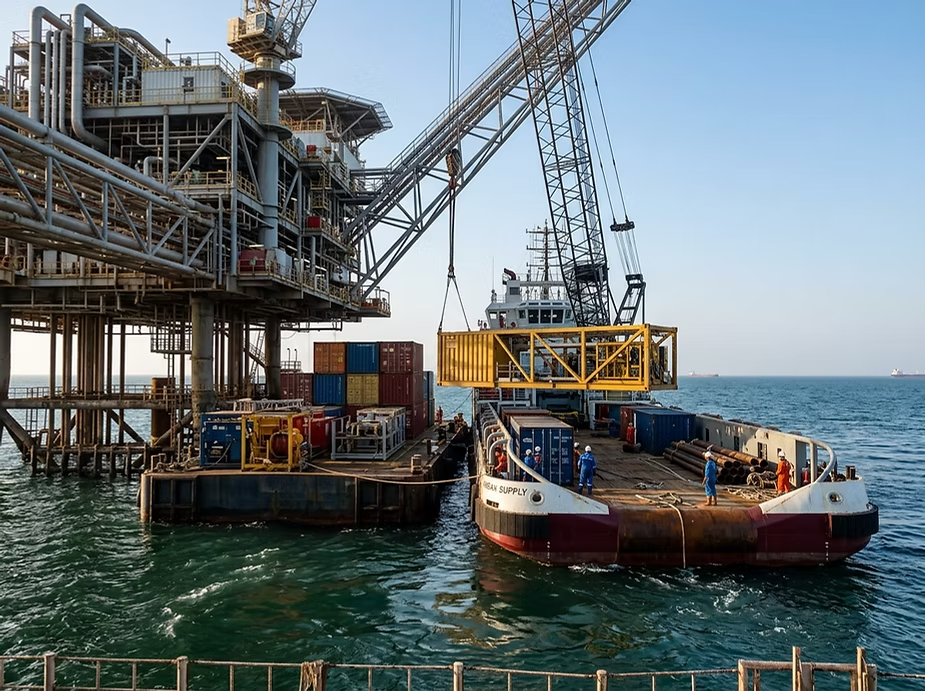
Most offshore operators manage a complex ecosystem involving:
Platform Supply Vessels (PSVs)
Anchor Handling Tug Supply Vessels (AHTS)
Multi Support Vessels (MSV)
Helicopter operations
Shore bases and warehouses
Fuel and water supply chains
Inventory management
Crew change logistics
Offshore installation support
While drilling and production costs are continuously monitored, logistics costs often remain fragmented across multiple departments, contracts, and service providers. This fragmentation conceals significant inefficiencies:
Low vessel utilization
Excess standby charges
Sub-optimal cargo planning
Extended turnaround time at supply bases
Emergency procurement and transport costs
Lack of integrated planning between marine, aviation, and shore-base functions
The result is silent cost escalation without corresponding production gains.
Industry is Already Moving Towards Integrated Logistics
The Indian offshore sector is recognizing this challenge.
As publicly reported, ONGC has initiated implementation of an Offshore Logistics Management System (OLMS) incorporating AI-driven scheduling, real-time marine and aviation asset tracking, and integrated operational visibility across offshore operations.
ONGC-AnnualReport_07082026.pdf further highlights logistics digitalization, strategic vessel planning, and improved resource utilization as key enablers of operational efficiency.
This is a significant step in the right direction.
However, the larger opportunity lies beyond tracking assets.
The future lies in transforming offshore logistics into an intelligent, predictive decision-support ecosystem.
What AI Can Do for Offshore Logistics
Most logistics decisions today are still reactive. AI can fundamentally change this model.
1. Predictive Vessel Scheduling
AI can analyze:
Cargo demand patterns
Production requirements
Rig activity schedules
Weather forecasts
Historical voyage performance
This enables dynamic vessel deployment and route optimization, minimizing fuel consumption and vessel idle time.
2. Helicopter Capacity Optimization
Crew change flights often operate below optimal occupancy.
AI-based planning systems can:
Consolidate crew movements
Optimize seating utilization
Reduce unnecessary flights
Improve weather-related rescheduling decisions
Even small improvements can generate substantial annual savings.
3. Digital Shore Base Management
Modern logistics systems can provide:
Real-time inventory visibility
RFID-enabled cargo tracking
Automated warehouse planning
Backload and return-material management
This reduces inventory carrying cost and improves material availability.
4. Predictive Inventory Planning
One of the largest hidden costs in offshore operations is working capital locked in inventory.
AI can forecast:
Consumption patterns
Equipment failure probabilities
Spare part requirements
Seasonal demand trends
This reduces both stock-outs and excess inventory.
5. Integrated Logistics Control Towers
Perhaps the most transformative concept is the creation of a digital logistics control tower.
Such a platform brings together:
Vessel schedules
Helicopter schedules
Cargo status
Warehouse inventory
Weather information
Rig requirements
Vendor performance
Cost analytics
into a single real-time dashboard.
Management receives a complete operational picture instead of fragmented reports from multiple functions.

The Deepwater Imperative
As India expands exploration and production activities into deepwater and ultra-deepwater areas, logistics complexity will increase exponentially.
Longer sailing distances, greater helicopter dependence, higher equipment intensity, and narrower operational windows will amplify the cost of inefficiency.
Every unnecessary vessel day, helicopter sortie, inventory duplication, or port delay will directly affect project economics.
This makes logistics optimization a board-level issue rather than merely an operational concern.
The Next Generation Offshore Logistics Model
The future offshore logistics organization will likely be built around five pillars:
Digital Visibility
Real-time tracking of every critical logistics asset.
AI-Driven Planning
Automated optimization of vessels, helicopters, inventory, and cargo.
Predictive Analytics
Forecasting rather than reacting.
Integrated Decision-Making
Marine, aviation, supply-chain, and shore-base functions working through one digital platform.
Continuous Cost Benchmarking
Identifying hidden inefficiencies and eliminating redundant expenditure.
A Strategic Opportunity for Indian Operators and Service Providers
For operators such as ONGC and Oil India, as well as service providers including Great Offshore and other offshore support companies, the opportunity is substantial.
The focus should no longer be restricted to acquiring additional logistics resources.
Instead, organizations should ask:
Are existing vessels being optimally utilized?
Is helicopter capacity fully leveraged?
Are inventories scientifically planned?
Is there duplication across supply bases?
Are logistics decisions data driven?
Is management getting a real-time integrated view of logistics performance?
These questions often reveal cost-saving opportunities without disrupting active offshore operations.
Final Thoughts
The future offshore logistics manager will not merely manage vessels, helicopters, warehouses, or contracts. The future role will involve managing an integrated digital ecosystem powered by AI, IoT, analytics, and real-time operational intelligence.
Organizations that embrace this transition will not only reduce operating costs but also improve production reliability, safety performance, and capital efficiency.
In an environment of increasing cost pressure and expanding offshore activity, logistics optimization is no longer optional. It is rapidly becoming a competitive advantage.
FINLOG E&P (Oil & Gas) Consultants supports operators and offshore service providers in identifying hidden logistics cost drivers, designing logistics restructuring initiatives, evaluating digitalization opportunities, and implementing practical cost-optimization strategies across marine, aviation, supply-chain, and shore-base operations without disrupting ongoing production activities.


Comments